


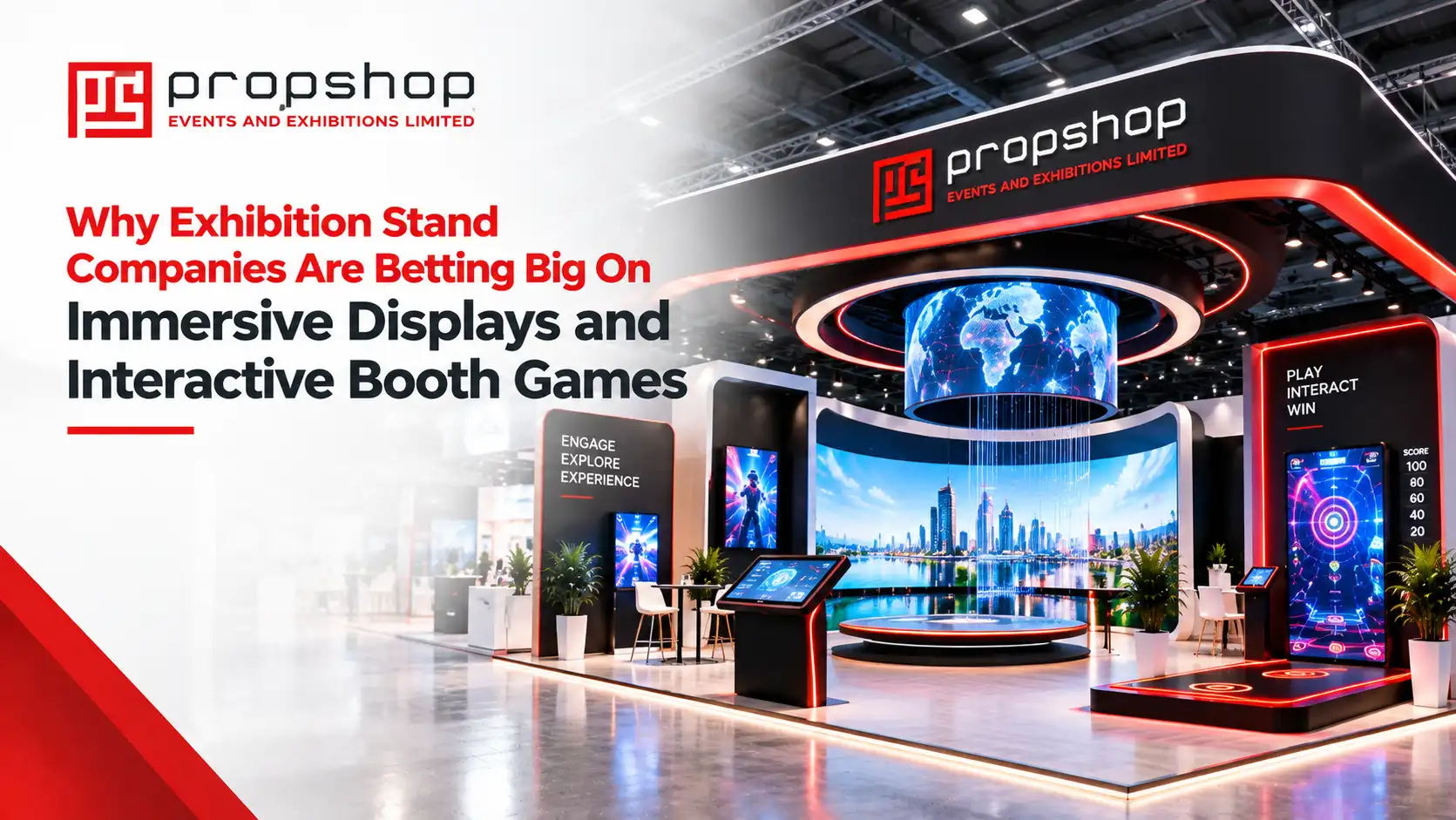
This shift isn't a trend that will fade in a season. It's a fundamental change in how exhibitors think about ROI, and it's why exhibition stand companies offering immersive exhibition displays are seeing a surge in demand from Indian brands exhibiting both at home and across Europe.
The Problem With "Nice-Looking" Stands
For years, a good exhibition stand meant clean design, strong branding, and a well-lit product wall. That's still the baseline, but it's no longer the differentiator. Buyers walking a trade show floor are overstimulated. They've seen a hundred backlit logos before lunch. What actually makes them pause is interaction.
This is the core insight behind immersive exhibition booth design: people remember what they do, not just what they see. A visitor who spends ninety seconds spinning a wheel, testing a product simulation, or playing a branded game at your booth walks away with a memory tied to your brand and, more importantly, a reason to talk to your sales team while they're still engaged.
What "Immersive" Actually Means for Exhibitors
The term gets thrown around loosely, so it's worth breaking down what genuinely immersive exhibition displays look like in practice:
Digital exhibition displays: Large-format LED walls, video mapping onto structural elements, and synchronised multi-screen storytelling that turns a flat backdrop into a moving narrative about your product or process.
Interactive exhibition booths: Touchscreen product configurators, AR-powered catalogue walls where visitors point a tablet at a product to see specs come alive, and VR stations that let a buyer "walk through" a factory floor or a finished installation without leaving the hall.
Experiential exhibition stands: Entire zones built around a sensory or physical experience: a driving simulator for an auto components brand, a texture wall for a materials company, a scent station for an F&B exhibitor.
Exhibition booth games and interactive booth games: Gamified lead capture through spin-the-wheel, trivia kiosks, AR treasure hunts, or leaderboard-based challenges that visitors compete on throughout the day, often tied to a small giveaway.
The best interactive trade show booths rarely use just one of these. They layer two or three together, so the booth has a rhythm: something to look at from a distance, something to touch up close, and something worth queuing up for.
Why This Matters More for Indian Exhibitors Going Abroad
If you're exhibiting at a European trade show, say, a manufacturing expo in Germany or a design fair in Italy, you're not just competing with other Indian companies. You're standing next to European, Chinese, and American exhibitors who often have significantly larger marketing budgets and a home-turf advantage. An immersive, interactive booth is one of the few ways a mid-sized Indian exhibitor can command the same attention as a much larger competitor, purely through smart design and experience rather than square footage.
There's also a practical business case. European buyers walk trade shows with dozens of appointments booked back-to-back. A booth that offers a two-minute interactive experience gives your team a natural, low-pressure way to start a conversation far more effective than a cold pitch the moment someone walks past your counter.
The ROI Argument: Why Interactive Isn't Just "Fun"
It's easy to dismiss booth games and digital displays as gimmicks. The data says otherwise. Interactive elements do three measurable things for an exhibitor:
- They increase dwell time. The longer a visitor stays at your booth, the more likely your sales team is to have a real conversation, not just a badge scan.
- They improve lead quality and capture. A gamified kiosk that requires an email or company details to "play" gives you structured lead data instead of a pile of business cards you'll never sort through.
- They make your booth shareable. Visitors photograph and post experiences, not static graphics. That's free, authentic visibility for your brand well beyond the show floor.
For exhibitors measuring cost-per-lead against booth spend, this is the difference between a stand that looks good in photos and one that actually moves people through your funnel.
What to Look for in an Exhibition Stand Partner
Not every stand builder can execute this well. Immersive and interactive elements require a different skill set than traditional carpentry and graphics; you need in-house or closely integrated capability across structural design, AV integration, software/app development for interactive touchpoints, and content creation for the digital displays themselves. When evaluating exhibition stand companies for this kind of work, ask specifically about:
- Past projects with functioning interactive or gamified elements (not just renders)
- In-house technical teams versus outsourced AV vendors, which affects both cost and on-site troubleshooting
- Experience working across international venues, since power specifications, rigging rules, and technical approvals vary significantly between Indian and European exhibition halls
- Post-show reporting can they hand you engagement data from the interactive elements, not just a wrap-up photo album?
Bringing This to Life on the Show Floor
The most successful immersive stands we've seen aren't the most expensive ones; they're the most intentional ones. A well-placed touchscreen product demo near the entrance, a single well-executed booth game with a strong prize incentive, and a digital display that tells your brand story in under thirty seconds can outperform a stand three times the budget that's visually impressive but passive.
The exhibition industry has moved past the era where a stand's job was simply to be seen. Today, a stand's job is to be experienced, and exhibitors who understand that difference are the ones walking away from trade shows in Germany, Italy, France, Spain, and India with genuinely qualified pipelines, not just a stack of scanned badges.
If you're planning your next stand, whether it's a domestic exhibition or a European trade show, it's worth having a conversation early about where immersive and interactive elements can fit into your budget and floor plan, rather than treating them as an afterthought bolted onto a traditional design.