
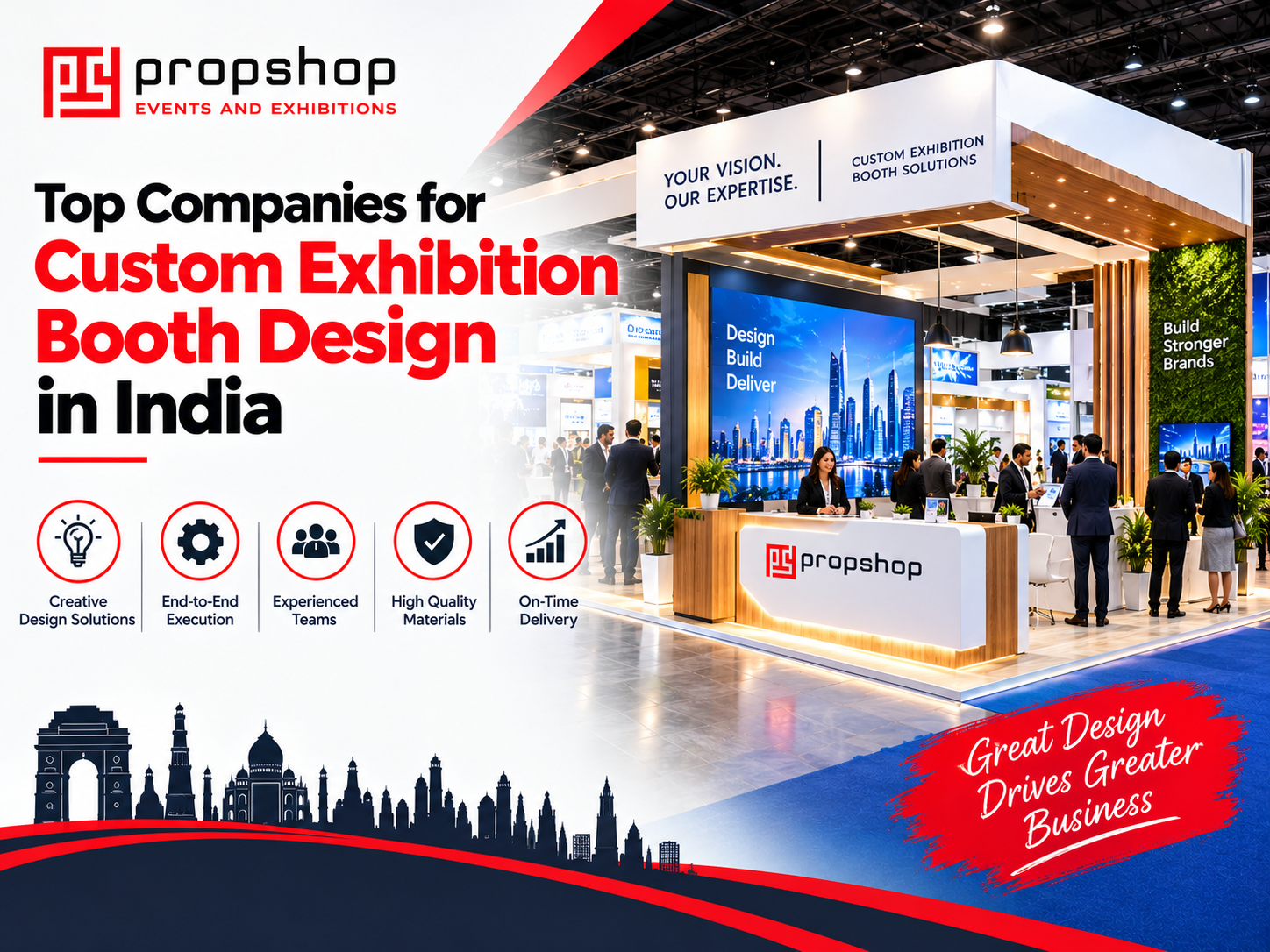
A standard modular kit might work for a small stall in the corner of a hall. But if you need real branding impact, a proper demo area, storage that doesn't eat into your footprint, or a layout built around how your specific visitors behave, custom is usually the better route. This article walks through what custom booth design actually involves, what to look for in a company, and a neutral shortlist of names worth researching.
What Is Custom Exhibition Booth Design?
Custom exhibition booth design means the stand is built from scratch around your brand and your specific requirements, rather than assembled from a fixed catalogue of panels and frames. The designer starts with your brand identity colours, materials, tone and works backwards from there: how big is the booth, what's the objective (lead generation, product launch, brand visibility), what needs to be displayed, how should visitors flow through the space, do you need a private meeting area, and what's the budget ceiling.
This is different from a generic or ready-made setup, where the same modular components get reused across clients with only the graphics changed. Ready-made stalls are faster and cheaper, and they're genuinely the right call for smaller budgets or repeat participation in low-stakes shows. Custom exhibition stand design costs more and takes longer to plan, but it also means nobody at the show has a booth that looks like yours, and the layout is actually built for your product rather than adapted to fit someone else's frame.
Why Choose a Custom Exhibition Booth for Your Brand?
The obvious answer is "it looks better," but that's only part of it. A custom stand lets the designer use your exact floor area efficiently instead of working around a pre-set module size, which matters a lot when you've been allotted an awkward shape or a corner booth versus an island. Product demonstration space can be built in rather than bolted on, so a company showing machinery or a live product run gets a layout that actually supports it instead of a table pushed against a wall.
Meeting areas are another practical difference. Serious B2B buyers often want a quiet five minutes away from the noise of the aisle, and a custom layout can carve that out without shrinking your display area. Storage is similarly underrated sample stock, spare literature, staff belongings, and packing material all need somewhere to go that isn't visible to visitors, and generic stalls rarely plan for this properly.
Lighting and graphics work better in custom builds too, because they're designed for the specific structure rather than adjusted to fit standard panel sizes. And if your brand exhibits at multiple shows a year, custom design gives you more flexibility to scale a concept up or down for different hall sizes while keeping the same visual identity intact.
What to Look for in Exhibition Booth Design Companies in India
Not every vendor calling itself a "custom" builder actually designs from scratch. A few things worth checking before you sign anything:
- Design capability and 3D visualization: Ask to see photorealistic 3D renders before production starts. If a company can only show you 2D floor plans, you're taking a bigger risk on the final look.
- Experience across booth sizes: A team that's mostly done small 9 sqm stalls may struggle with a 200 sqm island, and vice versa. Ask for examples close to your actual size.
- Fabrication capability: Some companies design in-house but outsource fabrication to third parties, which adds a layer of communication and risk. In-house fabrication generally means tighter quality control.
- Project management and communication: You want a single point of contact who can answer questions quickly during the run-up to the show, not a design team that goes quiet after the contract is signed.
- Installation, dismantling, and logistics: Confirm whether transport, on-site installation, and post-show dismantling are included or billed separately, and who handles removal of waste material.
- Venue and regulation knowledge: Different venues (Pragati Maidan, BIEC, HITEX, and others) have their own rules on stall height, rigging, fire safety, and electrical load. A company familiar with your specific venue avoids last-minute compliance issues.
- Material and finishing quality, portfolio, and transparent costing: Ask for an itemised quote rather than a single lump sum, so you know what you're paying for materials, labour, logistics, and contingencies.
Top Companies for Custom Exhibition Booth Design in India
This is a research-based, neutral shortlist of companies operating in this space. It isn't ranked, and it isn't exhaustive treat it as a starting point for your own due diligence, and confirm current details directly with each company before deciding.
- The Propshop India: Designs and fabricates custom exhibition stalls with a focus on turnkey delivery from structure and branding to graphics, installation, and dismantling — and has worked on projects for exhibitors across sectors including dairy and speciality chemicals. Website: thepropshopindia.com
- Panache Exhibitions: A full-service exhibition stall design, fabrication, and construction company based in Delhi, offering bespoke stand design for exhibitors across industries. Website: panache-worldwide.com
- Expo Stand Services: Offers exhibition stall design and fabrication across major Indian cities including Delhi, Mumbai, Bangalore, Ahmedabad, Pune, and Kolkata, with in-house 3D design and portable/reusable stall options. Website: expostandservice.com
- Insta Group: In-house design, fabrication, printing, logistics, installation, and dismantling, operating since 2003 with multiple production facilities and a client base spanning SMEs to larger corporates. Website: insta-group.com
- Woodpeckers Global: A Mumbai-headquartered exhibition stall design company with pan-India and UAE delivery, covering everything from compact one-side-open stalls to large island concepts, including industry-specific formats like jewellery and garment exhibition stalls. Website: woodpeckersglobal.com
- Stall Designs: Handles custom stands, modular booths, and larger structures including double-decker builds and country pavilions, managing 3D design through to installation and venue handover. Website: stalldesigns.com
Since exhibition needs vary a lot by industry, city, and booth size, it's worth requesting quotes from a shortlist of two or three companies rather than committing to the first one you speak with and asking each the same evaluation questions so you can compare answers directly, not just prices.
How Much Does Custom Exhibition Booth Design Cost in India?
There's no single fixed rate, because two booths of the same size can cost very differently based on what's actually inside them. Booth size and design complexity are the starting point a straightforward one-side-open 9 sqm stall costs far less than an island stall with a double-decker structure. Materials matter too: laminate and vinyl finishes are cheaper than veneer, fabric-tension structures, or custom millwork.
Beyond structure, costs stack up from graphics and printing, lighting (basic spotlighting versus programmable LED systems), AV and technology integration (screens, interactive displays, product demo tech), furniture rental or custom-built furniture, flooring, and any dedicated storage or meeting rooms built into the layout. Venue charges, including electrical connections, rigging permissions, and hall-specific compliance requirements, add another layer, as does the exhibition's city, since transport and labour costs differ across locations. Installation and dismantling timelines, especially if they require overnight or odd-hour labour, and the duration of the exhibition itself, also factor into the final number. Getting an itemised quote is the only reliable way to compare two vendors fairly.
Custom Exhibition Booth Design Process
A realistic workflow generally looks like this:
- Brief: You share objectives, booth size, budget, and brand guidelines.
- Concept: The design team proposes initial directions based on your brief.
- 3D Design: Photorealistic renders are created so you can visualise the finished stand.
- Design Approval: You review, request revisions, and sign off on the final concept.
- Production/Fabrication: Structural elements, graphics, and furniture are built or sourced.
- Quality Check: Materials and structures are inspected before dispatch.
- Logistics: Everything is transported to the venue, timed around access windows.
- Installation: The stand is assembled on-site, usually within a tight build-up window.
- Handover: You inspect the completed stand before the show opens.
- Dismantling: After the show, the stand is taken down and removed per venue deadlines.
How to Select the Right Custom Exhibition Booth Design Company
Before signing a contract, it helps to ask direct questions rather than relying on a sales pitch:
- Have you handled booths of a similar size before?
- Can you provide photorealistic 3D designs before production begins?
- Who manages fabrication, is it in-house or outsourced?
- Is installation included in the quoted price?
- What exactly is included in the quotation, and what's billed separately?
- How are design revisions handled, and how many rounds are included?
- What happens if venue requirements change close to the event date?
- Who manages transportation to and from the venue?
- What's the realistic project timeline from brief to installation?
- Is dismantling and waste removal included?
Getting clear answers to these upfront avoids most of the disputes that come up in the final week before a show.
Conclusion
Choosing a partner for custom exhibition booth design in India comes down to a handful of things that actually matter on the show floor: design capability, execution quality, communication throughout the project, project management discipline, and a genuine understanding of exhibition logistics and venue requirements. Price matters, but it shouldn't be the only factor — a cheaper quote that leaves out installation, dismantling, or revisions often ends up costing more once the gaps show up.
If you're planning an upcoming trade show and want to think through your options, feel free to share your exhibition name, booth size, venue, and general requirements it's a useful starting point for working out design ideas or getting a realistic quotation, with no pressure to commit.