

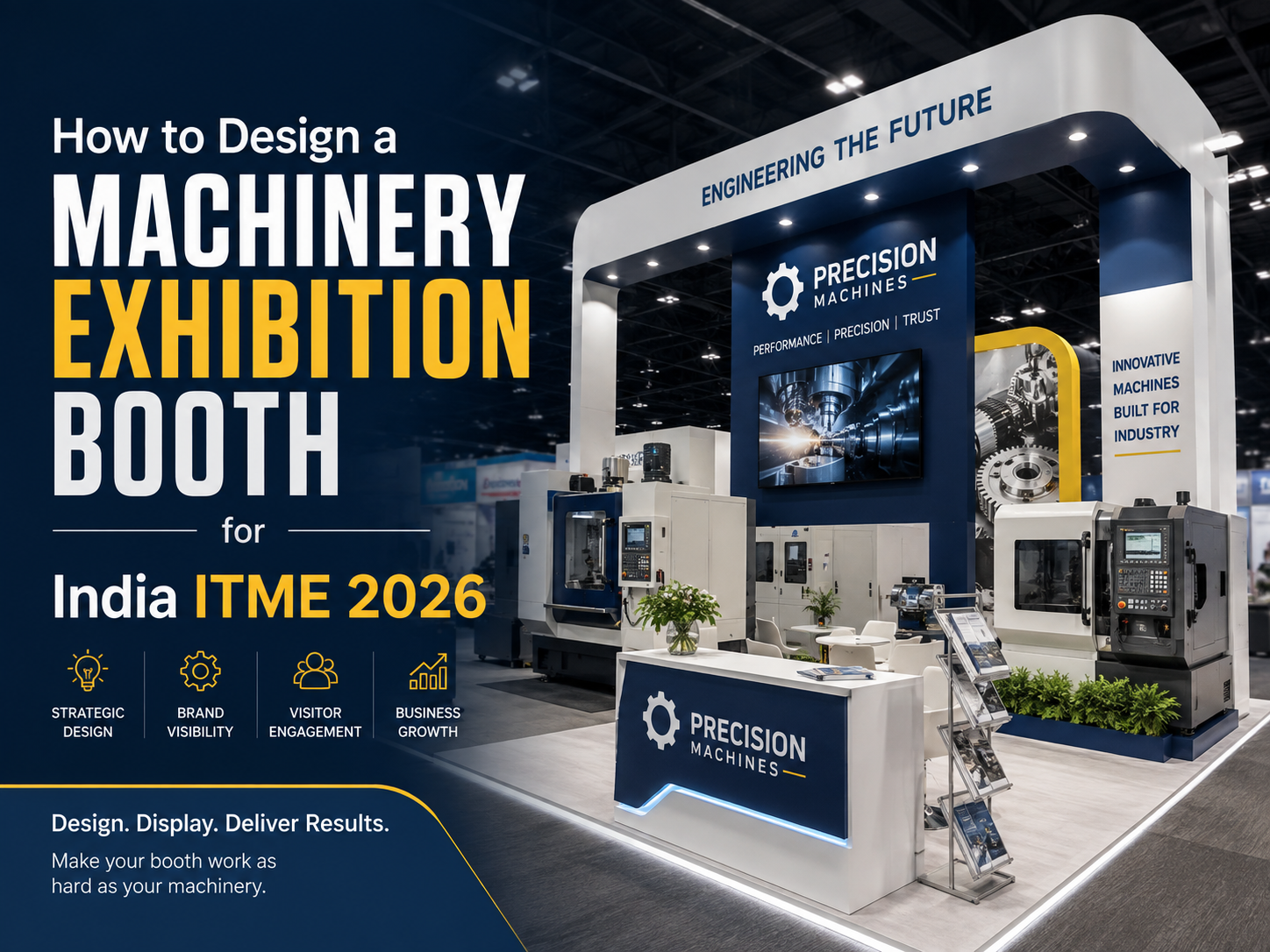
That's where exhibition booth design becomes a genuine business decision rather than a design afterthought. Unlike a consumer brand that can rely on a striking graphic wall, machinery exhibitors have to solve for space planning, sightlines, live demonstrations, safety, and visitor flow, all while still looking credible next to competitors doing the same. Choosing the right India ITME 2026 exhibition stall builder early in the process has a direct effect on how much attention your machinery gets, how many real conversations happen at your stand, and ultimately how many qualified leads you walk away with.
This article walks through practical, usable ideas for designing a booth that does its job — not just looks good in photos.
Why Booth Design Matters for Machinery Exhibitors at India ITME 2026
Machinery exhibitors face a different set of constraints than a typical B2B booth. A few of the realities that shape good design decisions:
- Large machinery needs strategic space planning. A spinning frame or processing line takes up real floor area, and that area has to be planned around, not just filled in.
- Visitors need clear sightlines. If a machine is boxed in by panels or other units, people simply won't stop to look at it.
- Technical specifications need to be easy to digest. Buyers are evaluating capability, output, and compatibility — not reading paragraphs of text on a wall.
- Live demonstrations increase engagement, but only if there's room for people to actually stand and watch.
- Safety and accessibility matter more here than in almost any other kind of stand, given moving parts, cabling, and foot traffic.
- Meeting spaces are essential, because textile machinery deals are rarely closed on the show floor in five minutes.
- Clear product zoning helps visitors self-navigate to what's relevant to them.
Picture a textile machinery manufacturer bringing three or four machines into one stand. If they're placed without a plan, the booth feels cramped, visitors can't move comfortably, and staff end up with less room to talk to anyone. Good textile machinery booth design starts by treating the machines as the layout's anchor points, not as objects to squeeze in around a stage or a reception desk.
Top Machinery Exhibition Booth Design Ideas for India ITME 2026
A. Make Machinery the Hero
The machinery should lead the design, not compete with it. That means strategic placement, raised platforms where it helps visibility, product-specific information panels next to each unit, and viewing areas that give visitors room to actually look before they approach your team.
B. Create Live Product Demonstration Zones
A working demonstration does more to explain a machine than any brochure. Set up a defined demonstration area with a clear line of sight for the operator, a technical screen nearby showing specs or output data, a rough demonstration schedule so visitors know when to come back, and QR codes linking to full technical documentation. If moving parts are involved, safety barriers and clear markings aren't optional.
A textile machinery manufacturer showing an automated winding or weaving process, for instance, benefits far more from a scheduled live run than from a static machine with a laminated spec sheet taped to it.
C. Use LED Screens and Video Walls
Video content works best when it supports the machinery rather than pulling attention away from it. Use screens to show the machine in operation in a factory setting, before-and-after production results, technical animations of how a mechanism works, or real customer use cases. Keep it looping quietly in the background rather than competing with live demonstrations for attention.
D. Build a Strong Brand Story
Visitors move fast on a show floor, so your messaging needs to answer five things quickly: who you are, what you manufacture, what problem you solve, why your technology is different, and how someone can start working with you. This works better as a few confident lines placed well than as a wall of technical copy.
E. Add Smart Lighting
Lighting does more work than most exhibitors give it credit for. Well-placed lighting highlights the machinery itself, improves how it photographs and films for social content, and gives the whole stand a more premium, industrial finish without needing extra structure.
F. Create Dedicated Meeting Areas
Distributor meetings, technical consultations, and dealer discussions need somewhere private enough to talk business. Semi-private meeting rooms or a few well-positioned meeting tables work well; just avoid closing off the booth so much that it feels unapproachable from the aisle.
G. Add Lead-Generation Counters
A reception or lead-capture point, positioned where it doesn't block circulation, gives your team a natural place to register interest through QR-code forms, digital enquiry capture, or catalogue downloads. Collecting details only pays off if your team is also qualifying visitors by business need and purchase intent, not just gathering business cards.
How to Design a Booth That Generates More Qualified Leads
Good aesthetics get people to stop. Good structure gets them to convert.
- Keep the layout open and inviting. Unnecessary walls make visitors hesitate before stepping in.
- Use clear calls to action such as "Book a Machinery Demo," "Talk to Our Technical Team," or "Get Product Specifications."
- Map the visitor journey: Attract → Engage → Demonstrate → Discuss → Capture Lead → Follow Up. Every part of the booth should support one of these steps.
- Segment by product category if you're showing multiple machinery lines, so visitors can find what's relevant to them without wandering.
- Use digital lead capture — QR codes, meeting-booking tools, and downloadable spec sheets to reduce friction for busy buyers.
Textile Machinery Booth Design: Balancing Technology and Space
Textile machinery exhibitors are juggling more variables than most: large equipment footprints, demonstration space, electrical load requirements, storage for spares and tools, staff circulation, and visitor movement all inside a fixed floor plan.
The exhibitors who get this right finalize machinery dimensions, power requirements, and demonstration plans well before fabrication starts. Trying to fit these details in after the design is locked almost always leads to compromises on-site. This is exactly the kind of planning covered in detail in this guide to India ITME exhibition stall design, which is worth reviewing early if machinery exhibition stall fabrication is part of your plan.
Sustainable and Technology-Driven Booth Ideas
Industrial and textile brands increasingly lean into practical sustainability: reusable booth structures, recyclable graphics, and energy-efficient LED lighting reduce both cost and waste across multiple shows. Pairing that with digital brochures, QR-code product information, interactive touchscreens, and AR/VR walkthroughs where relevant gives visitors a modern experience without adding physical clutter to the stand.
Common Machinery Exhibition Booth Design Mistakes to Avoid
- Trying to fit too many machines into limited space -it crowds the booth and hides your best products.
- Poor visitor circulation -if people can't move freely, they leave faster.
- Too much technical text -visitors skim; they don't read walls of copy.
- Weak or unclear branding -buyers should know who you are within seconds.
- Insufficient demonstration space - a great machine with no room to show it in action loses impact.
- No dedicated meeting area - serious buyers need somewhere to talk business.
- Ignoring storage requirements - tools, spares, and personal items end up cluttering the visible booth.
- Poor lighting - even well-built machinery looks flat under bad light.
- No lead-capture strategy - interest that isn't captured is interest that's lost.
- Starting fabrication too late - rushed builds mean rushed compromises.
- Designing without machinery dimensions finalized - this causes last-minute layout changes.
- Treating the booth as a display area rather than a sales environment - every element should support a business outcome.
Why Propshop India is Your Go-To Exhibition Stand Contractor for India ITME 2026
Exhibitors planning for India ITME 2026 need a partner who understands both exhibition design and the practical realities of machinery. Propshop India works across the full exhibition stand lifecycle:
- Exhibition Stall Design — Booth concepts built around your machinery, product range, brand identity, and expected visitor flow, rather than generic templates.
- Stall Fabrication — Translating an approved design into a functional structure that accounts for machinery placement, electrical load, lighting, and structural needs.
- Custom Booth Solutions — Tailored layouts for different booth sizes, machinery categories, and branding requirements, rather than one-size-fits-all builds.
- Project Management — Coordinated planning across design, fabrication, logistics, and installation, so nothing falls through the cracks close to the show date.
- On-Site Installation — Professional setup and coordination to make sure the booth is fully ready before doors open.
- End-to-End Exhibition Stand Solutions — Support from initial concept through to fabrication, installation, and on-ground execution.
- Planning your India ITME 2026 exhibition booth? Discuss your booth size, machinery requirements, branding goals, and budget with Propshop India to explore a suitable exhibition stand solution.