


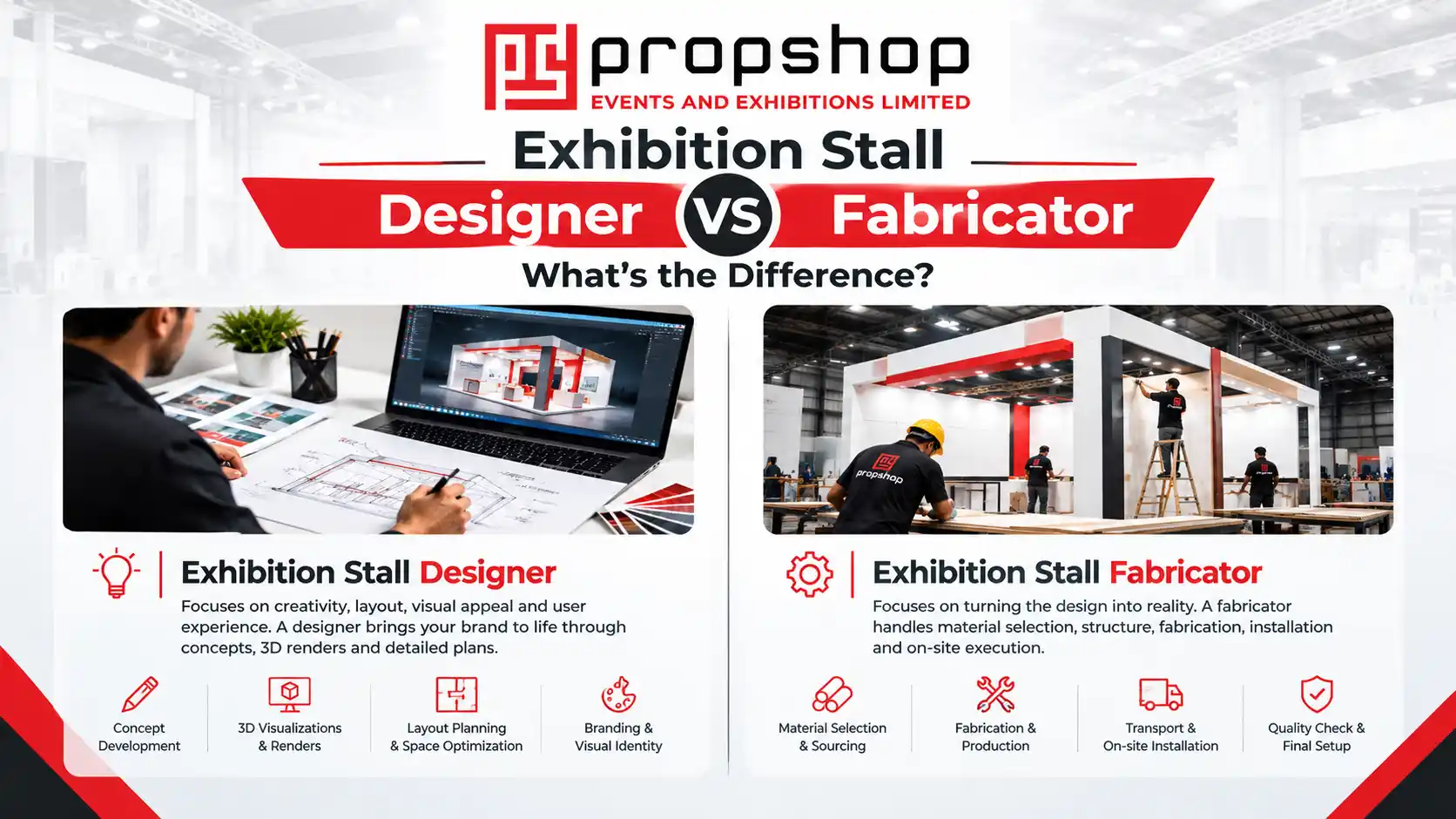
Let's break this down properly, because getting this wrong is one of the most common (and expensive) mistakes exhibitors make.
The Core Difference: Vision vs Execution
Think of it like building a house. An architect designs the structure, the layout, the aesthetics, the flow of space, the materials that will create the right impression. A contractor then builds it, dealing with the plumbing, the electrical wiring, the actual bricks and mortar that make the architect's drawing stand upright.
An exhibition stall designer is your architect. Their job is conceptual and strategic. They think about your brand positioning, visitor flow, visual hierarchy, and how your 3x3m or 6x6m space is going to make someone stop walking and actually engage with your team. They work in 3D renders, mood boards, and floor plans long before a single panel gets cut.
An exhibition stall fabricator, on the other hand, is the builder. They take that design and turn it into a physical, structurally sound stand — sourcing materials, managing carpentry and metalwork, handling electricals and lighting installation, and making sure the whole thing can survive being packed, shipped, and reassembled in a different city or country without falling apart.
Both roles are essential. Neither one can really succeed without the other.
What Does an Exhibition Stall Designer Actually Do?
A good stall designer isn't just making things "look nice." Their work usually involves:
- Understanding your brand guidelines and translating them into a spatial experience
- Studying the exhibition hall layout, your booth location, and neighboring stands
- Creating 3D visualizations so you know exactly what you're getting before construction begins
- Planning visitor movement where people enter, where they pause, where the meeting zones are
- Choosing materials, textures, lighting schemes, and color palettes that align with your industry and audience
- Balancing creative ambition with practical constraints like budget, venue rules, and build time
This is where the "wow factor" of a stand is born. If your stall designer is skilled, your booth doesn't just display your products; it tells a story that pulls foot traffic in from across the aisle.
What Does an Exhibition Stall Fabricator Actually Do?
Once the design is signed off, the fabricator takes over the harder, less glamorous but equally critical part of the job:
- Converting 3D designs into technical drawings and cutting lists
- Sourcing and procuring materials (wood, metal, fabric, laminates, acrylic, etc.)
- Managing carpentry, welding, painting, and finishing work
- Installing electricals, lighting, AV systems, and structural reinforcements
- Ensuring compliance with venue and fire safety regulations
- Handling logistics packing, transportation, on-site installation, and dismantling after the show
A fabricator's expertise is what determines whether your stand actually gets built on time, within budget, and without last-minute panic when a panel doesn't fit or a laminate color looks different under exhibition hall lighting than it did on a screen.
Why This Distinction Matters for Exhibitors
Here's where it gets practical. Many exhibitors, especially first-time ones, hire a designer who has no real fabrication experience, or a fabricator who has no design sensibility. The result?
You either get a gorgeous render that's nearly impossible (or absurdly expensive) to actually build, or you get a stand that's structurally solid but visually forgettable the kind that blends into a hundred other booths at the show.
There's also the coordination problem. When your designer and fabricator are two separate vendors with no shared accountability, you become the middleman managing miscommunication between them. Revisions take longer. Costs creep up because nobody wants to own a mistake. And if something goes wrong on-site in a foreign city, you're the one stuck troubleshooting it, not them.
This is exactly why more exhibitors, particularly Indian companies exhibiting in Germany, Italy, France, Spain, and the Netherlands, are moving toward companies that offer both design and fabrication under one roof.
Stall Design and Fabrication: Why the Combined Approach Wins
When design and fabrication sit within the same team, a few things change for the better:
Designs are built with buildability in mind from day one. A designer who works alongside fabricators naturally avoids proposing structures that look great on screen but are impractical or overly costly to construct.
Communication overhead disappears. There's no lag between "the designer wants this" and "the fabricator can actually do this." Changes get resolved in real time.
Accountability is clear. If there's an issue with quality or timeline, there's no vendor pointing fingers at another vendor. One team, one point of contact.
Cost predictability improves. Combined teams can estimate material and labor costs more accurately upfront, because the same people planning the look are also planning the build.
This matters even more for exhibitors going international. When your stand is being designed in India but built and installed in a European exhibition hall, having a team that understands both the creative and technical sides and that has already navigated cross-border logistics, customs, and on-ground execution removes a massive amount of risk.
So, Which One Do You Actually Need?
If you're exploring a trade show appearance, the honest answer is: you need both, working in sync. Whether that's through one integrated company or two vendors who genuinely collaborate well, don't settle for a disconnect between the people imagining your stand and the people building it.
When evaluating a potential exhibition partner, ask them directly: do you handle both stall design and fabrication in-house, or do you subcontract one of these? Ask to see past projects where they managed the full process end-to-end, especially in the specific country or venue you're targeting. Ask how they handle communication during the build phase if you're not able to be physically present.
The exhibitors who get the best return on their trade show investment are almost always the ones who treated design and fabrication as one connected process, not two separate transactions.